Java Interview Questions for 3 Years Experience (2026)
Master java interview questions for 3 years experience. Expert guide covering core concepts, frameworks, design patterns, and real scenarios.
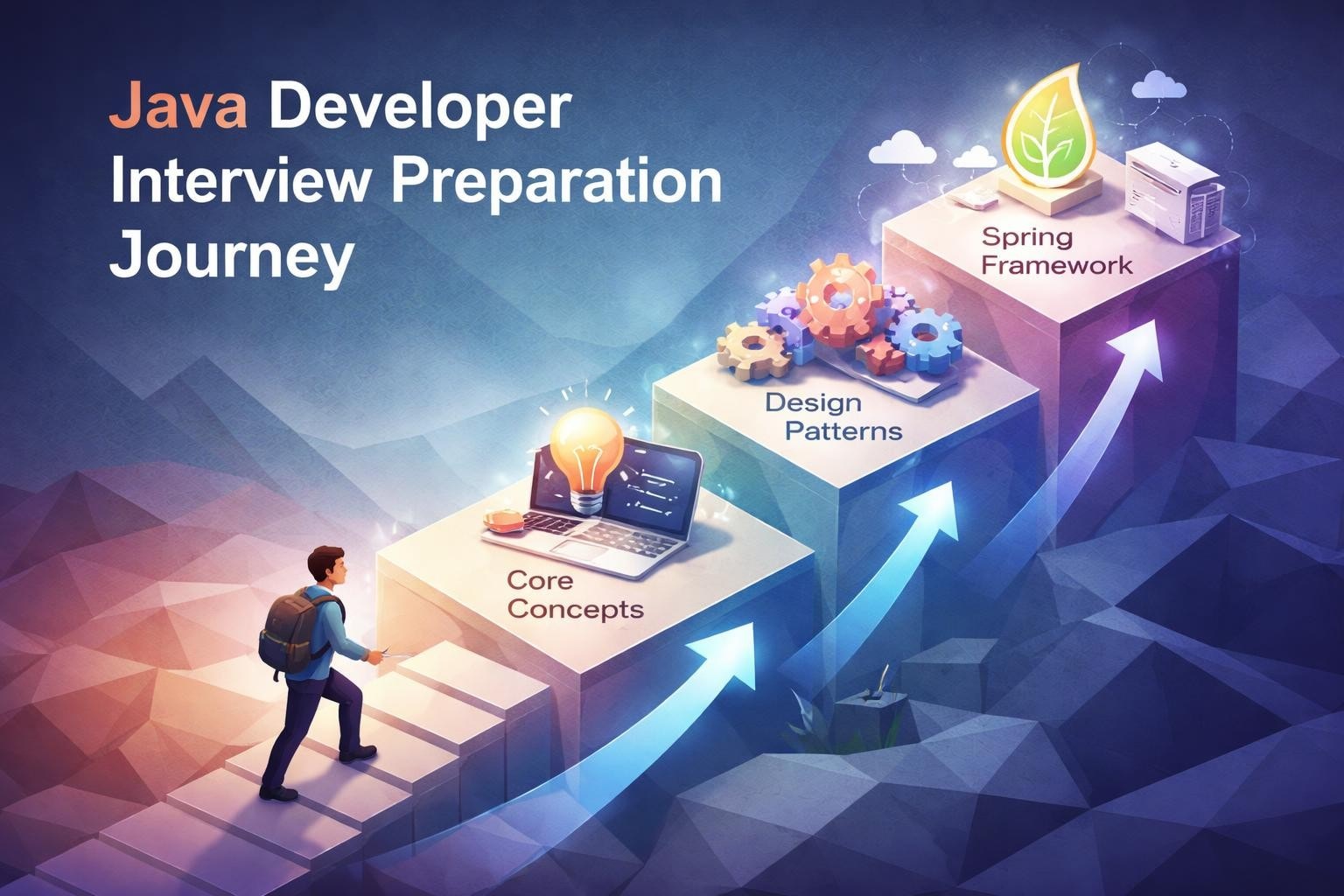
Landing a Java developer position with three years of professional experience requires demonstrating both foundational knowledge and practical application skills. As you transition from junior to mid-level roles in 2026, interviewers expect you to handle complex coding challenges, articulate design decisions, and showcase your understanding of enterprise frameworks. This comprehensive guide covers the most critical java interview questions for 3 years experience, helping you prepare for technical rounds with confidence and clarity.
Core Java Fundamentals You Must Master
At the three-year mark, interviewers assume you have solid command over Java basics. However, they'll probe deeper into your understanding rather than accepting surface-level answers.
Object-Oriented Programming Principles
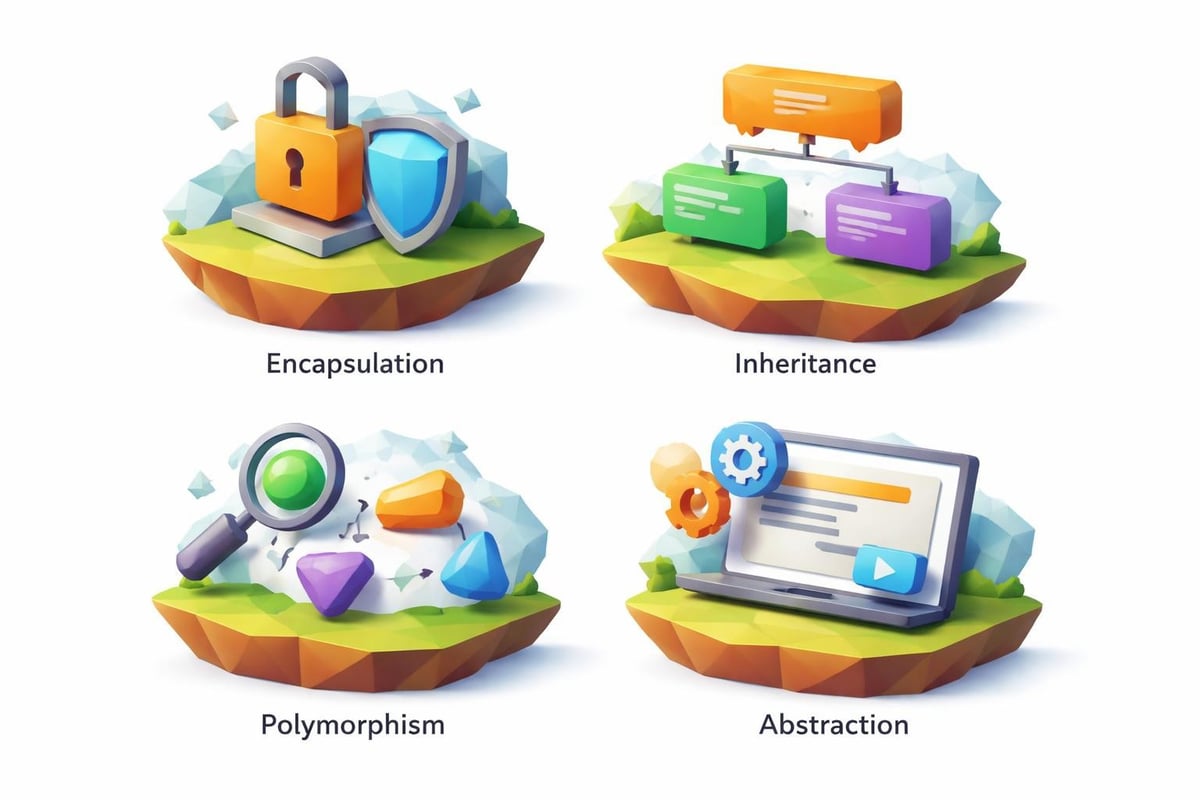
Encapsulation, inheritance, polymorphism, and abstraction form the foundation of every Java interview. With three years of experience, you should explain these concepts through real-world examples from your projects.
- Describe how you've used encapsulation to protect sensitive data in production applications
- Explain polymorphism with concrete examples of method overriding and overloading from your codebase
- Discuss when to use abstract classes versus interfaces, referencing actual architectural decisions
- Demonstrate understanding of composition over inheritance with practical scenarios
When asked about the difference between method overloading and overriding, mid-level candidates should go beyond textbook definitions. Explain how compile-time polymorphism (overloading) differs from runtime polymorphism (overriding) and when each approach benefits your application design.
Collections Framework Deep Dive
The Collections Framework questions separate experienced developers from beginners. You need to understand internal implementations, not just usage patterns.
| Collection Type | Use Case | Time Complexity | Thread-Safe Alternative |
|---|---|---|---|
| ArrayList | Fast random access | O(1) get, O(n) add/remove | CopyOnWriteArrayList |
| LinkedList | Frequent insertions/deletions | O(n) get, O(1) add/remove | Collections.synchronizedList |
| HashMap | Key-value storage | O(1) average | ConcurrentHashMap |
| TreeMap | Sorted key-value pairs | O(log n) | ConcurrentSkipListMap |
Expect questions about HashMap internals, including how it handles collisions, the significance of load factor, and changes introduced in Java 8 with tree-based buckets. Discuss when you've chosen TreeSet over HashSet based on sorting requirements or LinkedHashMap when insertion order mattered.
Multithreading and Concurrency Essentials
Three years into your career, you've likely encountered threading challenges in production environments. Interviewers want to know how you've solved real concurrency problems.
Thread Management and Synchronization
Understanding thread lifecycle, synchronization mechanisms, and the java.util.concurrent package is non-negotiable for mid-level positions. Be prepared to discuss:
- Thread creation approaches: Extending Thread class versus implementing Runnable interface versus using ExecutorService
- Synchronization techniques: Synchronized blocks, ReentrantLock, and when to apply each
- Volatile keyword: How it ensures visibility across threads without full synchronization overhead
- Deadlock prevention: Strategies you've employed to avoid circular dependencies in lock acquisition
- Thread pool management: Choosing appropriate executor types for different workloads
A common scenario question involves explaining how you'd implement a producer-consumer pattern using BlockingQueue. Your answer should reference actual implementations from your experience, demonstrating familiarity with CountDownLatch, CyclicBarrier, or Semaphore when appropriate.
Modern Concurrency Utilities
Java's evolution has introduced powerful concurrency tools that experienced developers should leverage. Discuss your experience with CompletableFuture for asynchronous programming, explaining how it simplifies callback chains and error handling compared to traditional Future objects. The interview preparation resources at CareerConcierge.io can help you structure these technical responses effectively.
Spring Framework and Enterprise Java
Most Java positions with three years of experience requirement involve Spring ecosystem knowledge. This separates academic understanding from practical application skills.
Spring Core and Dependency Injection
Dependency Injection (DI) and Inversion of Control (IoC) questions dominate Spring interviews. Beyond defining these patterns, explain how they've improved your application's testability and maintainability.
- Describe the difference between constructor injection, setter injection, and field injection
- Explain Spring bean scopes (singleton, prototype, request, session) with use cases from your projects
- Discuss @Autowired versus @Resource versus @Inject annotations
- Detail the Spring bean lifecycle and how you've used init and destroy methods
When asked about circular dependencies in Spring, demonstrate awareness of common solutions: constructor injection refactoring, @Lazy annotation usage, or redesigning the dependency graph.
Spring Boot and Microservices
By 2026, Spring Boot dominates enterprise Java development. Interviewers assess your ability to build production-ready applications efficiently.
| Spring Boot Feature | Purpose | Key Annotation |
|---|---|---|
| Auto-configuration | Reduces boilerplate setup | @SpringBootApplication |
| Actuator | Production monitoring | @EnableActuator |
| Data JPA | Database abstraction | @Repository |
| REST Controllers | API development | @RestController |
Prepare to discuss how you've configured external properties, implemented health checks, managed database migrations with Flyway or Liquibase, and secured REST APIs using Spring Security. Your answers should reflect hands-on experience with deployment, monitoring, and troubleshooting production issues.

Design Patterns and Best Practices
With three years of experience, you should recognize when and how to apply common design patterns. This knowledge distinguishes developers who write maintainable code from those who simply make things work.
Creational, Structural, and Behavioral Patterns
Familiarity with Singleton, Factory, Builder, Adapter, Decorator, Observer, and Strategy patterns is expected. However, interview scenarios for experienced developers focus on pattern application rather than theoretical knowledge.
Singleton Pattern Considerations:
- How do you implement thread-safe singletons without performance penalties?
- When have you used enum-based singletons for guaranteed single instance?
- What alternatives exist for global state management?
Factory and Builder Patterns: Explain situations where you've chosen Factory Method over Abstract Factory, or when Builder pattern simplified object creation with numerous optional parameters. Reference actual classes from your codebase to demonstrate practical application.
SOLID Principles in Practice
Mid-level developers must articulate how SOLID principles guide their design decisions:
- Single Responsibility: Each class should have one reason to change
- Open/Closed: Open for extension, closed for modification
- Liskov Substitution: Subtypes must be substitutable for base types
- Interface Segregation: Many specific interfaces beat one general-purpose interface
- Dependency Inversion: Depend on abstractions, not concretions
Prepare specific examples showing how you've refactored code to adhere to these principles, improving testability and reducing coupling. The senior Java developer interview insights can provide additional context for advancing your architectural thinking.
JVM Internals and Performance Optimization
Questions about memory management, garbage collection, and performance tuning assess your ability to build scalable applications and diagnose production issues.
Memory Architecture and Garbage Collection
Understanding heap versus stack memory, garbage collection algorithms, and JVM tuning parameters proves invaluable for mid-level positions.
- Explain the difference between Young Generation, Old Generation, and Metaspace
- Describe when objects move from Eden space to Survivor spaces to Tenured generation
- Compare Serial, Parallel, CMS, and G1GC collectors with appropriate use cases
- Discuss memory leak scenarios you've diagnosed using heap dumps and profiling tools
When asked about garbage collection tuning, reference specific JVM flags you've adjusted (-Xmx, -Xms, -XX:+UseG1GC) and the performance improvements observed. This demonstrates production experience rather than academic knowledge.
Performance Profiling and Optimization
Experienced developers should discuss tools and techniques for identifying bottlenecks:
- Profiling with VisualVM, JProfiler, or YourKit
- Analyzing thread dumps to diagnose deadlocks or high CPU usage
- Using JMX for runtime monitoring and management
- Identifying memory leaks through heap analysis
- Optimizing database queries with connection pooling and statement caching
Share specific optimization stories: reducing response times by implementing caching strategies, improving throughput by tuning thread pool sizes, or eliminating memory leaks by fixing resource cleanup issues.
Exception Handling and Error Management
Proper exception handling separates professional code from amateur implementations. With three years of experience, you should demonstrate sophisticated error management strategies.
Checked versus Unchecked Exceptions
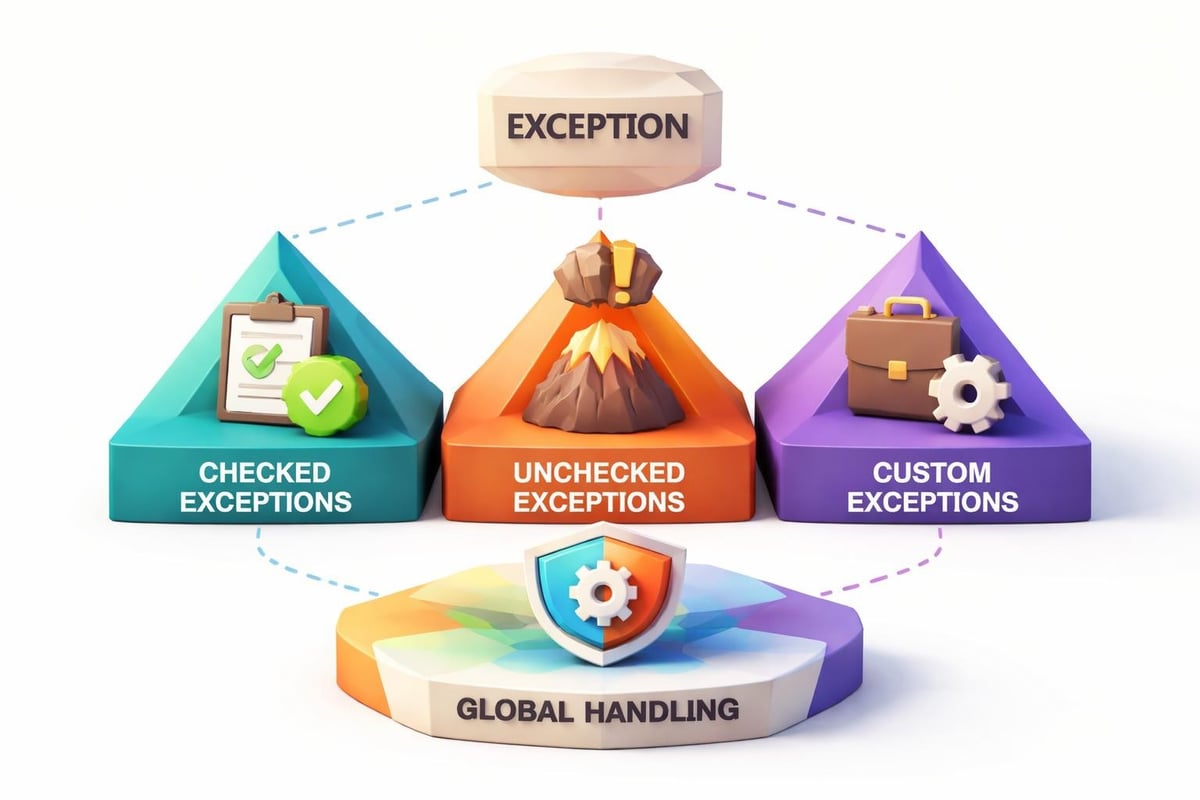
Explain when to use checked exceptions for recoverable conditions versus unchecked exceptions for programming errors. Discuss how exception handling best practices have evolved, particularly with modern frameworks preferring unchecked exceptions for cleaner code.
Common Exception Scenarios:
- Custom exception hierarchies for domain-specific errors
- Exception translation at architectural boundaries
- Global exception handling with @ControllerAdvice in Spring
- Logging strategies that balance debugging needs with log volume
Avoid the anti-pattern of catching generic Exception types or swallowing exceptions silently. Demonstrate awareness of try-with-resources for automatic resource management and CompletableFuture's exception handling methods.
Database Integration and JPA
Most Java applications interact with databases, making JDBC, JPA, and Hibernate essential knowledge areas for java interview questions for 3 years experience.
JDBC Fundamentals and Best Practices
While modern frameworks abstract direct JDBC usage, understanding the foundation remains important:
- Explain Connection, Statement, PreparedStatement, and ResultSet lifecycle management
- Discuss SQL injection prevention through parameterized queries
- Describe transaction management with commit and rollback operations
- Detail connection pooling configuration with HikariCP or Apache DBCP
JPA and Hibernate Expertise
Java Persistence API (JPA) and its most popular implementation, Hibernate, feature prominently in enterprise Java interviews. Be prepared to discuss:
| Concept | Explanation | Common Pitfall |
|---|---|---|
| Entity Mapping | @Entity, @Table, @Column annotations | Forgetting to annotate getters/fields consistently |
| Relationships | @OneToMany, @ManyToOne, @ManyToMany | N+1 query problems from lazy loading |
| Fetching Strategies | LAZY vs EAGER loading | LazyInitializationException |
| Caching | First-level and second-level cache | Stale data from improper cache invalidation |
Explain the difference between persist, merge, and save methods in Hibernate. Discuss how you've optimized queries using JPQL or Criteria API, implemented pagination for large result sets, and handled the N+1 query problem through fetch joins or entity graphs.
Testing and Quality Assurance
Professional developers with three years of experience write testable code and maintain comprehensive test suites. Interviewers assess your testing philosophy and practical skills.
Unit Testing with JUnit and Mockito
Demonstrate familiarity with modern testing frameworks:
- Writing effective unit tests with JUnit 5 annotations (@Test, @BeforeEach, @AfterEach)
- Mocking dependencies with Mockito to isolate units under test
- Using ArgumentCaptor to verify method interactions
- Implementing parameterized tests for multiple input scenarios
- Measuring code coverage with JaCoCo or similar tools
Discuss your approach to test-driven development (TDD), explaining when you've used it to clarify requirements or improve design. The object-oriented programming interview concepts often connect directly to writing testable, modular code.
Integration and End-to-End Testing
Beyond unit tests, experienced developers implement integration tests verifying component interactions:
- Spring Boot's @SpringBootTest for application context testing
- TestContainers for database integration tests with real database instances
- MockMvc for testing REST APIs without starting the full server
- Contract testing with tools like Pact for microservices communication
Share examples of how comprehensive testing prevented production bugs or enabled confident refactoring of legacy code. Mention continuous integration practices and your role in maintaining build pipeline health.
RESTful Web Services and API Design
Modern Java applications frequently expose or consume REST APIs. Interviewers assess your ability to design, implement, and secure web services professionally.
REST Principles and HTTP Methods
Explain Representational State Transfer (REST) principles beyond simple CRUD operations:
- Statelessness: Each request contains all necessary information
- Resource-based URLs: Nouns representing entities, not actions
- HTTP methods: GET for retrieval, POST for creation, PUT for updates, DELETE for removal
- HATEOAS: Hypermedia as the Engine of Application State for discoverability
- Idempotency: PUT and DELETE operations produce same result regardless of repetition
Discuss API versioning strategies (URL versioning versus header-based versioning), content negotiation with Accept headers, and pagination implementation for large data sets. Reference actual APIs you've designed, explaining decisions around endpoint structure and response formats.
API Security and Authentication
Security considerations dominate modern API development:
- OAuth 2.0 and JWT tokens for stateless authentication
- API keys and rate limiting to prevent abuse
- CORS configuration for cross-origin resource sharing
- Input validation to prevent injection attacks
- HTTPS enforcement for data transmission security
Describe authentication flows you've implemented, from simple basic authentication to complex OAuth providers with refresh tokens. The system design interview preparation resources can help you articulate security architecture decisions clearly.
Practical Coding Challenges
Beyond theoretical knowledge, java interview questions for 3 years experience always include hands-on coding exercises. Prepare for algorithmic problems and practical application scenarios.
Common Coding Problems
Practice these frequently asked challenges:
- Implement custom HashMap functionality demonstrating understanding of hashing and collision resolution
- Reverse a linked list iteratively and recursively
- Find the longest substring without repeating characters
- Implement binary search tree operations (insertion, deletion, traversal)
- Solve the producer-consumer problem using Java's concurrency utilities
- Design a parking lot system applying object-oriented principles
When solving problems, think aloud to demonstrate your problem-solving approach. Discuss time and space complexity using Big O notation. Consider edge cases like null inputs, empty collections, and boundary conditions.
Real-World Application Scenarios
Expect scenario-based questions requiring architectural thinking:
- Design a URL shortening service: Discuss hash generation, database schema, scaling strategies
- Implement a cache with expiration: Choose appropriate data structures, handle concurrency
- Build a rate limiter: Select algorithms (token bucket, leaking bucket), manage distributed state
- Create a notification system: Design message queuing, handle failures, ensure delivery
These scenarios assess your ability to translate requirements into technical solutions, considering scalability, reliability, and maintainability. Reference real interview experiences to understand how companies structure these discussions.
Behavioral and Situational Questions
Technical skills alone don't secure offers. Interviewers evaluate cultural fit, communication abilities, and professional maturity through behavioral questions.
STAR Method for Structured Responses
Answer behavioral questions using the Situation, Task, Action, Result framework:
- Situation: Describe a challenging project involving legacy code refactoring
- Task: Explain your responsibility to improve performance without breaking existing functionality
- Action: Detail specific steps like profiling, identifying bottlenecks, implementing caching
- Result: Quantify improvements (50% response time reduction, decreased server load)
Common behavioral topics include handling conflicts with team members, managing tight deadlines, learning new technologies quickly, and taking ownership of production incidents. Prepare 4-5 stories demonstrating different competencies.
Questions About Your Experience
Interviewers often ask about your previous projects, technologies used, and lessons learned. Be ready to discuss:
- Most complex technical challenge you've solved and your approach
- Mistakes you've made and how you've grown from them
- Technologies you've learned independently and how you stay current
- Contributions to code quality through reviews, documentation, or mentoring
- How you've balanced technical debt against feature delivery
Frame answers positively, focusing on growth and learning rather than blaming others. Similar to other professional interview scenarios, demonstrating self-awareness and continuous improvement resonates with hiring managers.
Emerging Java Technologies and Trends
Staying current with Java's evolution demonstrates professional commitment and adaptability. Discuss recent developments showing you're not stagnant in your learning.
Modern Java Features
Java has evolved significantly beyond version 8. Show awareness of recent enhancements:
- Records (Java 14+): Concise immutable data carriers replacing verbose POJOs
- Sealed classes (Java 17): Restrict class hierarchies for better domain modeling
- Pattern matching: Simplify instanceof checks and switch expressions
- Text blocks: Multi-line string literals improving readability
- Virtual threads (Java 21): Lightweight concurrency without traditional thread overhead
Discuss how you've adopted these features or plan to leverage them in future projects. This forward-thinking perspective appeals to companies investing in modern technology stacks.
Microservices and Cloud-Native Development
In 2026, containerization and cloud deployment dominate enterprise Java development:
- Docker containerization: Package applications with dependencies for consistent deployment
- Kubernetes orchestration: Manage containerized applications at scale
- Spring Cloud: Build distributed systems with service discovery, configuration management
- Reactive programming: Handle high-throughput scenarios with Project Reactor or RxJava
Share experience with cloud platforms (AWS, Azure, GCP), continuous deployment pipelines, and monitoring tools like Prometheus or Grafana. Understanding these ecosystems positions you as a well-rounded mid-level developer ready for modern architectures.
Preparing for java interview questions for 3 years experience requires balancing foundational knowledge with practical application skills, demonstrating both technical depth and professional maturity. Your success depends not only on knowing core Java concepts but also on articulating how you've applied them to solve real business problems. CareerConcierge.io provides comprehensive interview preparation tools, including AI-powered practice sessions and personalized feedback, helping you present your three years of experience with confidence and clarity. Whether you're refining your resume to highlight relevant projects or practicing technical responses, our platform streamlines your preparation for landing that next career opportunity.