12 Must-Know OOP Interview Questions for 2026 Success
Master OOP interviews in 2026 with 12 must know oop interview questions, practical examples, and expert insights to boost your confidence and land your next tech role.
OOP skills will be non-negotiable in 2026 tech interviews, making strong preparation essential for every aspiring developer. This article is designed to help you master your next interview with 12 must-know oop interview questions that recruiters are prioritizing across Java, Python, C++, and more. As employers increasingly seek candidates with proven OOP expertise, you will discover vital concepts, practical code examples, and expert strategies to gain a competitive edge. Ready to become the candidate every company wants? Dive in and start building your interview confidence today.
The Importance of OOP in 2026 Tech Interviews
Object-Oriented Programming (OOP) continues to shape the landscape of software engineering in 2026. As companies seek adaptable, innovative developers, mastering oop interview questions becomes a crucial differentiator for candidates. The ability to understand and apply OOP principles is now a standard expectation across technical roles.
The Enduring Relevance of OOP
OOP remains the backbone of modern software development, powering everything from enterprise systems to web and mobile applications. Languages like Java, Python, C++, and C# all rely on OOP constructs, making them essential for technical interviews. In 2026, job postings consistently list OOP as a top skill, reflecting its widespread adoption across industries.
Companies use OOP to build scalable, maintainable, and modular solutions. For example, enterprise resource planning systems employ OOP for complex business logic, while mobile apps leverage it for reusable components. OOP knowledge signals to employers that a candidate can organize code efficiently and think critically about software architecture.
Technical assessments and coding challenges frequently test candidates on OOP concepts. Mastery of these topics demonstrates strong problem-solving abilities and a readiness to tackle real-world projects. Hiring managers value candidates who articulate their design decisions and apply principles such as encapsulation, inheritance, and polymorphism with confidence.
For those preparing, resources like Top Object-Oriented Programming Interview Questions offer further insight into the types of oop interview questions most commonly asked, helping candidates benchmark their readiness.
What Interviewers Look For
In 2026, interviewers expect candidates to demonstrate a solid grasp of core OOP principles, including encapsulation, abstraction, inheritance, and polymorphism. Beyond basic definitions, candidates must apply these concepts to solve real-world problems and articulate their reasoning.
There is a marked shift toward scenario-based and conceptual questions. Interviewers might ask you to design a system, refactor legacy code, or analyze the trade-offs of different inheritance models. These oop interview questions are designed to probe both theoretical understanding and practical application.
Depth and adaptability are key. Candidates who can discuss design patterns, explain their approach, and justify their choices stand out. However, common pitfalls remain: confusing abstraction with encapsulation, overusing inheritance, or neglecting access control. Awareness of these mistakes, combined with practice, can help candidates excel when faced with challenging oop interview questions.
12 Must-Know OOP Interview Questions for 2026 Success
Preparing for 2026 tech interviews means mastering the most relevant oop interview questions. This guide covers the top 12 questions, blending essential theory with practical examples to help candidates excel. For deeper practice, explore this OOP Interview Questions and Answers resource, which complements the topics discussed below.
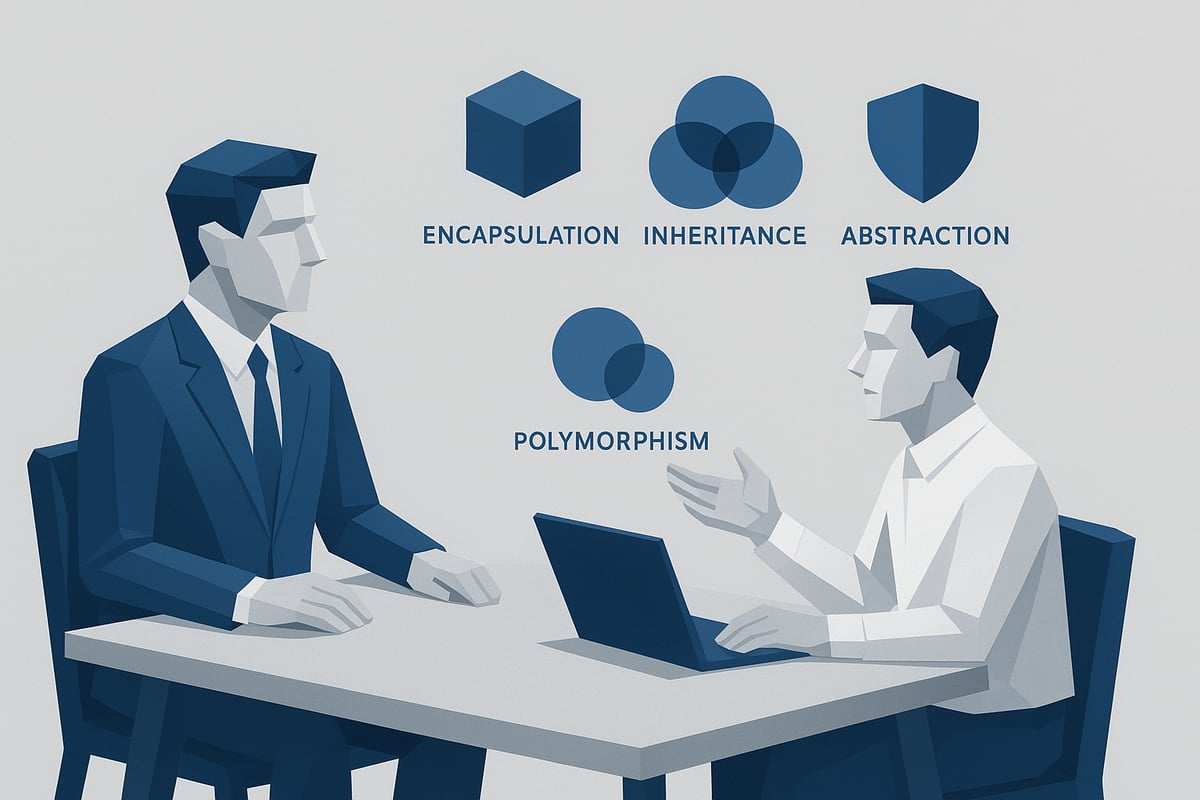
1. Explain the Four Pillars of OOP: Encapsulation, Abstraction, Inheritance, and Polymorphism
The four pillars of object-oriented programming (OOP) form the backbone of robust software design, and are central in oop interview questions.
- Encapsulation: Bundling data and methods that operate on that data within a single unit, usually a class. This helps protect the internal state of an object from outside interference.
- Abstraction: Hiding complex implementation details and exposing only the necessary features. For example, a car's driver uses the steering wheel without knowing the mechanics beneath.
- Inheritance: Mechanism for creating new classes based on existing ones, promoting code reuse. For instance, a
Dogclass can inherit from anAnimalclass. - Polymorphism: Allowing objects to be treated as instances of their parent class, enabling one interface to represent different underlying forms.
These pillars interact to ensure code is maintainable, scalable, and adaptable. In interviews, expect follow-up oop interview questions like asking for real-world analogies or code samples.
class Animal:
    def speak(self):
        pass

class Dog(Animal):
    def speak(self):
        return "Woof"
2. What is the Difference Between a Class and an Object?
A common oop interview questions topic is distinguishing between a class and an object.
- Class: A blueprint or template defining attributes and behaviors. It does not occupy memory until instantiated.
- Object: A concrete instance of a class, occupying memory and having actual values.
Memory Allocation:
- Class: No memory for data is allocated.
- Object: Memory is allocated for fields defined in the class.
Example in Python:
class Car:
    pass

my_car = Car()  # Object
Understanding this difference is essential, as confusing the two can lead to errors in code structure and logic. Interviewers often probe for misconceptions, such as assuming classes themselves store data.
| Aspect | Class | Object |
|---|---|---|
| Definition | Blueprint | Instance |
| Memory | Not allocated | Allocated |
| Example | Car |
my_car = Car() |
3. How Does Inheritance Work and What Are Its Types?
Inheritance allows a new class to acquire properties and behaviors of an existing class, a frequent subject in oop interview questions.
Types of Inheritance:
- Single: One subclass inherits from one superclass.
- Multiple: A subclass inherits from more than one superclass (supported in C++, not in Java).
- Multilevel: A class is derived from another derived class.
- Hierarchical: Multiple subclasses share a single superclass.
- Hybrid: Combination of two or more types above.
Example:
class Animal {};
class Dog : public Animal {}; // Single inheritance
Class Hierarchy Diagram:
Animal
  ├── Dog
  └── Cat
Language support varies; for example, Java uses interfaces to mimic multiple inheritance, while C++ supports it directly. Interviewers may ask candidates to design hierarchies or explain the pros and cons of each type.
4. What is Polymorphism? Differentiate Between Compile-Time and Runtime Polymorphism
Polymorphism, a core concept in oop interview questions, lets you use a unified interface for different underlying forms.
- Compile-Time Polymorphism: Achieved via method or operator overloading, determined at compile time.
- Runtime Polymorphism: Achieved via method overriding, determined at runtime.
Examples:
// Compile-time
int add(int a, int b)
int add(int a, int b, int c)

// Runtime
class Animal {
    void speak() { System.out.println("Animal"); }
}
class Dog extends Animal {
    void speak() { System.out.println("Dog"); }
}
Polymorphism increases code flexibility and reuse. Interviewers may test understanding by asking for real-world examples, like drawing shapes with a single draw() method for different shape types.
5. How is Encapsulation Achieved in OOP? Why is it Important?
Encapsulation is a frequent focus in oop interview questions due to its role in data protection.
- Definition: Wrapping data and related methods into a single unit, typically a class.
- Implementation: Using access specifiers (
private,public,protected) to restrict direct access.
Example in Java:
class Person {
    private String name;
    public String getName() { return name; }
    public void setName(String n) { name = n; }
}
Benefits:
- Enhances maintainability
- Improves security
- Promotes modularity
A common misconception is equating encapsulation with abstraction. Interviewers may ask how encapsulation prevents data misuse in real applications.
6. What is Abstraction and How is it Implemented?
Abstraction, a staple in oop interview questions, simplifies complex systems by exposing only essential features.
- Definition: Hiding complex details, exposing only what is necessary.
- Difference from Encapsulation: Encapsulation is about hiding data, while abstraction is about hiding complexity.
Implementation:
- Abstract Classes: Classes with abstract methods (no implementation).
- Interfaces: Define method signatures without implementation.
Example in Java:
abstract class Shape {
    abstract void draw();
}
Abstraction helps manage software complexity. Interviewers may follow up by asking for examples or differences between abstract classes and interfaces.
7. What are Access Specifiers/Modifiers? Give Examples
Access specifiers are a foundational topic in oop interview questions, controlling visibility of class members.
- Public: Accessible from anywhere.
- Private: Accessible only within the class.
- Protected: Accessible within the class and subclasses.
- Default (Java): Package-level access.
Example in C++:
class Demo {
private:
    int x;
public:
    void setX(int val) { x = val; }
};
Proper use ensures code integrity and security. Interviewers may ask candidates to identify the right specifier for a scenario or spot access-related bugs.
8. Differentiate Between Method Overloading and Method Overriding
Understanding the difference between these concepts is a common theme in oop interview questions.
- Method Overloading: Same method name, different parameters within the same class. Achieves compile-time polymorphism.
- Method Overriding: Subclass provides a specific implementation for a method already defined in its superclass. Achieves runtime polymorphism.
Example in Java:
// Overloading
void print(int a) {}
void print(String b) {}

// Overriding
class A { void show() {} }
class B extends A { void show() {} }
Overloading is used for convenience, while overriding customizes behavior. Candidates often confuse when to use each, so interviewers test for clear understanding.
9. What is an Interface? How Does it Differ from an Abstract Class?
A frequent oop interview questions subject is distinguishing interfaces from abstract classes.
- Interface: Defines a contract with method signatures, no implementation (until Java 8, which added default methods).
- Abstract Class: Can have both abstract (unimplemented) and concrete (implemented) methods.
Comparison Table:
| Feature | Interface | Abstract Class |
|---|---|---|
| Methods | Only signatures | Can implement |
| Multiple Inheritance | Yes | No (Java) |
| Constructors | No | Yes |
Use Cases: Use interfaces for unrelated classes sharing capabilities, abstract classes for closely related ones. Interviewers may ask for scenarios or language-specific differences (e.g., C# vs. Java).
10. Explain Constructors and Their Types
Constructors are key in oop interview questions related to object initialization.
- Definition: Special methods called when an object is created, initializing state.
- Types:
- Default Constructor: No parameters.
- Parameterized Constructor: Takes arguments.
- Copy Constructor: Creates a new object as a copy of an existing one (common in C++).
Examples:
class Point {
public:
    Point() {} // Default
    Point(int x, int y) {} // Parameterized
    Point(const Point &p) {} // Copy
}
Constructor overloading allows flexible object creation. Interviewers may test knowledge of best practices and pitfalls, such as unintentional shallow copies.
11. What are the Advantages and Disadvantages of OOP?
Discussing pros and cons is a staple in oop interview questions.
Advantages:
- Reusability via inheritance
- Modularity through encapsulation
- Scalability and maintainability
Disadvantages:
- Increased complexity
- Steeper learning curve
- Possible performance overhead
Real-World Example: Large enterprise systems use OOP for maintainability but may face performance issues in high-frequency trading apps. Interviewers want to see candidates balance enthusiasm for OOP with practical awareness of its challenges.
12. What is the Difference Between a Structure and a Class in C++?
This is a classic among oop interview questions, especially for C++ roles.
- Structure: By default, members are public; primarily for data grouping.
- Class: By default, members are private; supports full OOP features (encapsulation, inheritance, etc.).
Example:
struct Person {
    int age;
};
class Employee {
    int salary;
};
Key Differences:
- Access specifier default (public for struct, private for class)
- Intended use (struct for passive data, class for active behavior)
- Both support member functions in C++, but classes are preferred for OOP.
Understanding these differences shows attention to language-specific nuances, which interviewers value.
Advanced OOP Concepts and Scenario-Based Questions
The landscape of oop interview questions is evolving rapidly as we approach 2026. Technical interviews now emphasize not just theoretical knowledge, but also the ability to apply advanced OOP concepts in real-world scenarios. This shift means candidates must demonstrate practical design skills and critical thinking, moving beyond memorized definitions.

Real-World Scenarios in OOP Interviews
In 2026, oop interview questions often revolve around practical scenarios. Instead of direct definitions, interviewers may ask you to design a class hierarchy for an e-commerce platform, refactor legacy code to implement design patterns, or optimize an existing system’s architecture. These tasks test how well you can translate OOP principles into robust, scalable solutions.
For instance, you might be asked to implement the Strategy or Observer pattern to solve a real business problem. Interviewers assess your ability to apply principles like SOLID and DRY when structuring your answers. Demonstrating clear thought processes and justifying your decisions is crucial. Candidates who articulate why they chose composition over inheritance or how encapsulation improves maintainability stand out.
Preparing for these advanced challenges requires hands-on practice. Engage in mock interviews that focus on system design and OOP scenarios. The System design mock interview tips guide is an excellent resource for understanding how these interviews unfold. Additionally, reviewing Object-Oriented Programming Interview Questions can help you tackle complex problems and deepen your understanding of advanced OOP topics.
Top tech companies often present open-ended scenarios, such as designing a payment processing module or refactoring a monolithic application into modular components. To excel, structure your responses, communicate trade-offs, and always relate your choices back to OOP principles.
Common Pitfalls and How to Avoid Them
Many candidates struggle with advanced oop interview questions due to common pitfalls. Confusing abstraction with encapsulation, misusing inheritance, or neglecting proper access control can undermine your answers. For example, overusing inheritance may lead to rigid code, while inadequate encapsulation exposes sensitive data.
To avoid these mistakes, practice identifying the right OOP concept for each situation. Instead of defaulting to inheritance, consider composition and interfaces when appropriate. Carefully manage access specifiers to enforce encapsulation and maintain code integrity.
Hiring managers note that top performers consistently justify their design decisions and explain the reasoning behind chosen patterns. They also communicate clearly, breaking down complex problems into manageable steps. Mock interviews and coding exercises are invaluable for building these skills. By simulating real interview scenarios, you can refine your responses, recognize patterns in questions, and strengthen your overall OOP proficiency.
Continuous self-assessment and reflection are essential. Review your answers, seek feedback, and stay updated on the latest OOP trends. This proactive approach will prepare you for the most challenging oop interview questions in 2026.
Preparing for OOP Interviews: Strategies and Resources
Preparing for 2026 tech interviews requires more than memorizing definitions. Success hinges on mastering core concepts, applying them to real scenarios, and demonstrating confidence when answering oop interview questions. With the right strategies and resources, you can build the expertise and adaptability top employers seek.

Building a Strong OOP Foundation
A robust grasp of object-oriented programming fundamentals is essential for tackling any oop interview questions. Start by coding regularly in languages like Java, Python, or C++. Build small projects that demonstrate the four pillars of OOP, such as encapsulation, inheritance, abstraction, and polymorphism.
Explore official documentation and reputable textbooks. Engaging with peers through study groups or coding forums can lead to new insights and clarify doubts. Practice by solving real-world problems and implementing class hierarchies or design patterns.
Leverage online resources to deepen your understanding. Comprehensive guides, such as the Interview preparation for freshers, offer step-by-step strategies for technical interviews, including those focused on OOP. Reviewing open-source projects on platforms like GitHub exposes you to production-level code and best practices.
Stay updated on language-specific features that may appear in 2026 interviews. Regularly attempt coding challenges and quizzes based on oop interview questions to reinforce your knowledge and boost confidence.
Mock Interviews and Continuous Improvement
Consistent practice with mock interviews is a proven way to excel at oop interview questions. Simulate real interview scenarios, either with peers or using online platforms, to build comfort and identify areas needing improvement.
Create or join a study group dedicated to OOP concepts. Peer feedback is invaluable for refining your answers and addressing common mistakes. Track your progress by noting which questions you answer confidently and which require further review.
Use self-assessment tools to gauge your readiness. After each mock session, reflect on your performance. Did you communicate your reasoning clearly? Were your code examples concise and relevant?
Challenge yourself with unique or difficult problems by referencing resources like the Interesting interview questions guide. This will prepare you for unexpected twists in oop interview questions and help you think on your feet.
Finally, remain adaptable. Interview trends evolve, and companies may introduce new scenarios or technologies. Regular reflection and dedication to continuous learning will position you as a standout candidate in 2026 interviews.
You’ve just explored the must know OOP interview questions that can set you apart in the competitive 2026 tech landscape. Mastering these concepts is just one part of your journey—making your resume stand out and preparing with real world scenarios are equally important. If you’re ready to put your knowledge into action and take the next step toward your dream job, you don’t have to do it alone. Let CareerConcierge io’s AI powered tools help you optimize your resume, prepare for interviews, and boost your confidence every step of the way. Get Started Free