Top 12 SRE Interview Questions You Must Know in 2026
Prepare for success with the top 12 SRE interview questions for 2026. Gain expert insights, practical tips, and the latest trends to advance your SRE career.

The demand for Site Reliability Engineers is set to soar in 2026, as companies race to keep their digital systems reliable and scalable. Organizations are offering higher salaries and more opportunities for those who can master the essential sre interview questions.
This article is designed to help you stand out in the competitive SRE job market. We will guide you through the top 12 sre interview questions, providing detailed insights and practical strategies for success.
You will explore SRE fundamentals, technical and behavioral questions, key concepts, and real-world scenarios. Whether you are new to the field or aiming to advance your career, these questions will help you demonstrate your expertise and reliability mindset.
Ready to take the next step? Dive in and prepare to master the sre interview questions that matter most in 2026.
Understanding the SRE Role in 2026
The role of Site Reliability Engineer (SRE) is transforming rapidly as organizations prioritize reliability and efficiency in their digital operations. Understanding the evolving landscape of SRE is critical for anyone preparing for sre interview questions in 2026.
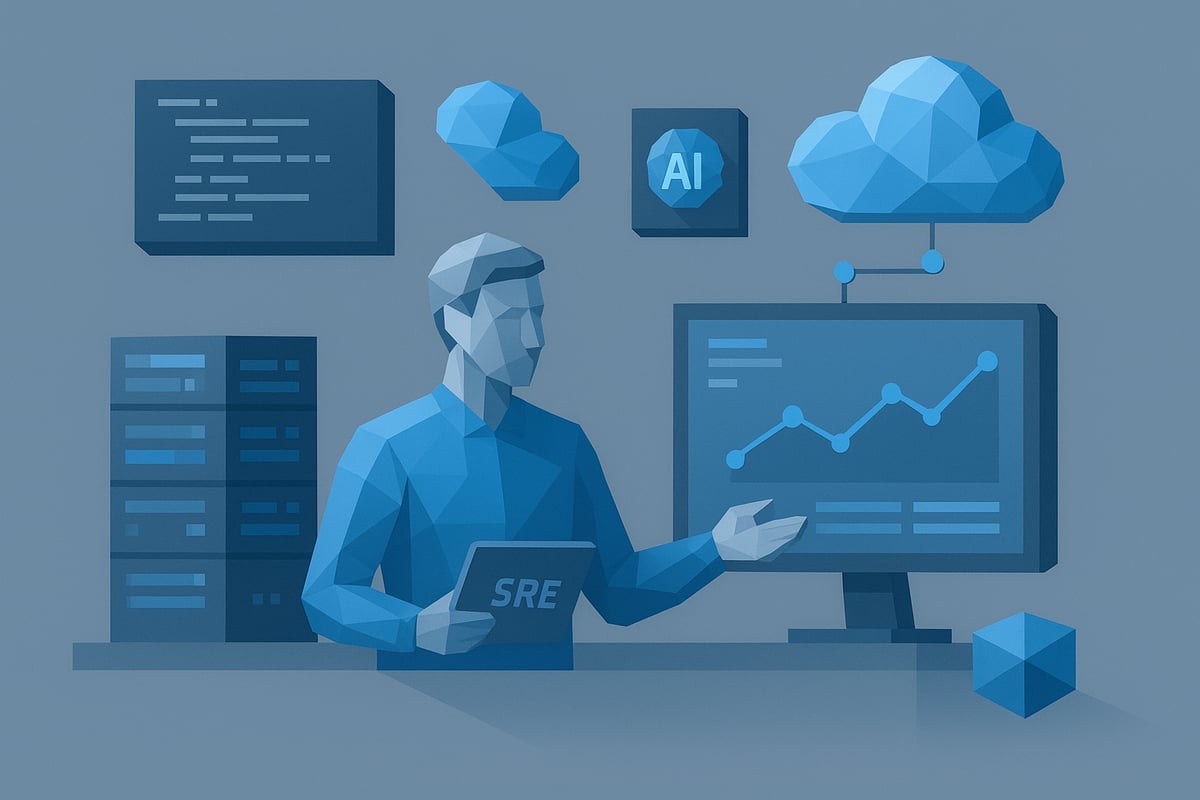
What Is SRE and How Has It Evolved?
Site Reliability Engineering originated at Google in the early 2000s, designed to ensure that large-scale systems remain reliable, scalable, and efficient. Over the years, SRE has evolved to become a foundational discipline in tech organizations, moving beyond simple uptime monitoring to embrace automation, proactive incident management, and service stability.
Today, SREs are not just system caretakers. They actively contribute to software delivery pipelines, automate operational tasks, and champion reliability as a measurable engineering goal. This historical evolution is a key context for sre interview questions, as employers seek candidates who understand both the roots and the future of the field.
The Hybrid Nature and Core Responsibilities of SRE
SREs operate at the intersection of software engineering and IT operations. This hybrid nature enables them to write code that automates manual processes, while also managing infrastructure at scale. Their core responsibilities include:
- Ensuring reliability and uptime of critical services
- Building automation for deployment and monitoring
- Managing scalability and performance
- Responding to incidents and learning from failures
Mastery of these areas is essential for those facing sre interview questions, as interviewers prioritize candidates who can balance development skills with operational expertise.
Table: Core SRE Responsibilities and Related Skills
| Responsibility | Related Skills |
|---|---|
| Reliability | Monitoring, SLIs/SLOs, Alerts |
| Automation | Scripting, CI/CD, IaC |
| Scalability | Load balancing, Caching |
| Incident Response | Troubleshooting, Communication |
Key Trends Shaping SRE in 2026
By 2026, SREs are adopting new technologies and practices to stay ahead. AI-driven monitoring tools are becoming standard, providing predictive insights and reducing manual toil. Cloud-native infrastructure, including containers and serverless platforms, is reshaping how services are deployed and managed.
Other trends include the integration of machine learning for anomaly detection, the rise of multi-cloud and edge computing, and a stronger focus on security automation. These developments directly influence the types of sre interview questions candidates should expect, as organizations look for engineers comfortable with emerging tools and paradigms.
SRE Job Growth, Impact, and Interview Focus
The demand for SREs is climbing, with competitive salaries and strong job security. According to the SRE Salary Guide 2026, median salaries for SREs continue to rise, reflecting their value in the tech sector.
Leading companies like Google, Netflix, and Amazon attribute much of their operational excellence to high-performing SRE teams. Their impact can be seen in faster incident resolution, improved customer satisfaction, and innovation without compromising reliability.
For those preparing for sre interview questions, it is important to demonstrate not only technical depth but also a proactive, reliability-focused mindset. Employers increasingly seek individuals who can drive continuous improvement and adapt to the fast-paced changes of the tech landscape.
The Top 12 SRE Interview Questions You Must Know in 2026
Preparing for SRE interviews in 2026 requires more than technical knowledge. The landscape is evolving, and employers are looking for candidates who can demonstrate both depth and adaptability. Mastering the most common sre interview questions can set you apart in this competitive field.
These 12 sre interview questions are carefully chosen to reflect the core expectations of modern SRE roles. They cover technical concepts, practical scenarios, and behavioral insights. To answer effectively, use the STAR method—describe the Situation, Task, Action, and Result—while weaving in technical depth and real-world examples.
Approach each question with clarity. Interviewers value structured thinking, hands-on experience, and a strong understanding of SRE fundamentals. The following sections break down each of the top sre interview questions for 2026, offering actionable insights for your success.

1. [Explain the Difference Between SRE and DevOps]
SRE and DevOps are often mentioned together, but they are not identical. DevOps focuses on cultural collaboration between development and operations, aiming to streamline delivery and reduce silos. SRE, however, is a specific implementation of DevOps principles, emphasizing reliability, automation, and measurable service levels.
Both roles share tools and goals, but SREs use engineering to solve operations problems. For example, at Google, SRE teams write code to automate deployment, while DevOps might focus on the overall process. This sre interview questions topic is foundational because it tests your understanding of industry structure.
Interviewers want to see that you can clearly articulate the overlap and boundaries. Use real-world examples to show how SREs and DevOps collaborate, yet maintain distinct responsibilities.
2. [What Are Service Level Indicators (SLIs), Service Level Objectives (SLOs), and Service Level Agreements (SLAs)?]
Understanding SLIs, SLOs, and SLAs is central to answering sre interview questions. SLIs are specific metrics (like latency or uptime) that measure service performance. SLOs are defined targets for those metrics, such as "99.9% uptime per month." SLAs are formal agreements with customers based on those objectives, often including consequences for breaches.
For example, a video streaming service may set an SLO for 99.99% playback success. SREs use these metrics to balance innovation and reliability. Defining SLOs poorly can lead to customer dissatisfaction or excessive operational toil.
Interviewers expect you to discuss how these concepts guide decisions and to mention best practices, such as involving stakeholders in SLO setting.
3. [Describe the Concept of Error Budgets and Their Role in SRE]
Error budgets are a cornerstone of sre interview questions. An error budget quantifies the acceptable amount of unreliability in a system, calculated as 1 minus the SLO (e.g., 0.1% downtime allowed for a 99.9% SLO).
Error budgets guide release decisions. If the error budget is depleted, new releases pause until reliability improves. This fosters collaboration between product and operations teams, balancing speed and stability.
For instance, if a new feature causes outages, the team may halt deployments until the error budget recovers. Monitoring tools track error budget consumption, making enforcement transparent.
4. [How Do You Approach Incident Management and Post-Incident Reviews?]
Incident management is a core topic in sre interview questions. The lifecycle includes detection, rapid response, resolution, and learning. Automation and monitoring tools like PagerDuty or Opsgenie enable faster detection and response.
A key principle is the blameless postmortem: after an incident, teams analyze root causes without assigning blame, fostering a culture of learning. Effective incident analysis includes documenting what happened, why, and how to prevent recurrence.
Communication during incidents is critical. Strong SREs ensure stakeholders are informed and follow up with actionable improvements.
5. [What Is Toil, and How Do You Reduce It?]
Toil is repetitive, manual work that adds little long-term value. Excessive toil drains productivity and morale, making its reduction a frequent focus in sre interview questions. Common sources include manual deployments, on-call tasks, and routine monitoring.
Automation is the primary strategy for reducing toil. Tools like Ansible or custom scripts can eliminate repetitive tasks. For example, automating log rotation or server provisioning can save hours weekly.
Reducing toil aligns with SRE principles by freeing engineers to focus on higher-impact projects and system reliability improvements.
6. [Explain Observability and How to Improve System Observability]
Observability, a frequent topic in sre interview questions, is the ability to understand a system’s internal state from its external outputs. It relies on three pillars: metrics, logs, and traces. Unlike traditional monitoring, observability enables proactive troubleshooting and deeper insights.
Tools like Prometheus and Grafana help SREs visualize and analyze system health. Improved observability leads to faster root cause analysis and reduced downtime. For example, distributed tracing exposes bottlenecks in microservices architectures.
In 2026, AI-driven observability platforms will offer predictive insights, helping teams resolve issues before they escalate.
7. [What Are the Key Differences Between Processes and Threads?]
This sre interview questions topic tests your understanding of operating systems. Processes are independent execution units with separate memory spaces, while threads share memory within a process.
Processes are heavier, with higher resource consumption, but offer better isolation. Threads are lightweight, enabling efficient multitasking but requiring careful synchronization to avoid conflicts.
Understanding these differences is crucial for troubleshooting and optimizing resource usage. For example, a memory leak in a multithreaded application can impact all threads, while in a multiprocess setup, the impact is contained.
| Aspect | Processes | Threads |
|---|---|---|
| Memory | Separate | Shared |
| Performance | Higher overhead | Lower overhead |
| Isolation | Strong | Weaker |
8. [How Would You Secure Docker Containers in Production?]
Docker container security is a recurring theme in sre interview questions. Best practices include scanning images for vulnerabilities, running containers with least privilege, and setting resource limits.
Tools like Docker Bench and third-party scanners automate security checks. Supply chain security is essential—always use trusted base images and verify dependencies. Runtime protections, such as seccomp or AppArmor, limit container capabilities.
A real-world example: a compromised container due to outdated libraries was mitigated by automated image scanning and rapid patching. In 2026, expect more AI-driven tools for proactive container security.
9. [Describe the Use and Importance of Inodes in Linux Systems]
Inodes are fundamental in Linux and often appear in sre interview questions. An inode stores metadata about a file—permissions, ownership, timestamps, and pointers to data blocks—but not the filename.
Inode exhaustion occurs when a filesystem runs out of available inodes, preventing new files from being created even if disk space remains. Troubleshooting involves checking inode usage with df -i and cleaning up small, unnecessary files.
For SREs, understanding inodes is essential for diagnosing storage issues and maintaining healthy systems.
10. [What Is Cloud Computing and How Does It Relate to SRE?]
Cloud computing is delivering computing resources over the internet. It includes Infrastructure as a Service (IaaS), Platform as a Service (PaaS), and Software as a Service (SaaS). SREs increasingly manage cloud-native systems, making this a staple in sre interview questions.
Cloud environments offer scalability but introduce reliability and security challenges. SRE practices in AWS, Azure, or GCP involve automated deployments, monitoring, and incident response.
Trends in 2026 include serverless architectures, multi-cloud strategies, and edge computing, all requiring SREs to adapt reliability techniques for diverse environments.
11. [Explain SNAT and DNAT and Their Importance in Network Management]
SNAT (Source Network Address Translation) and DNAT (Destination NAT) are crucial networking concepts in sre interview questions. SNAT changes the source IP address—commonly used in outbound traffic from private networks. DNAT modifies the destination IP, enabling services like load balancing.
For example, a load balancer uses DNAT to direct incoming requests to the appropriate backend server. Misconfiguration can lead to connectivity or security issues.
SREs often configure NAT rules for cloud services or firewalls. Interviewers look for clear explanations and awareness of common pitfalls.
12. [What Performance Monitoring Tools Are You Familiar With and How Do You Use Them?]
Performance monitoring tools are central to sre interview questions. Popular options include Prometheus for metrics, Grafana for dashboards, New Relic and Datadog for full-stack monitoring, and Nagios for legacy systems.
Each tool supports reliability by enabling alerting, dashboarding, and root cause analysis. Integration with automation platforms accelerates incident response. For example, Prometheus alerts can trigger self-healing scripts.
Staying current with monitoring trends is vital. In 2026, AI-powered analytics and predictive monitoring will be standard features. For more on system design scenarios relevant to SRE, see system design interview questions.
Technical Concepts and Core Skills for SREs in 2026
Site Reliability Engineers in 2026 must master a broad spectrum of technical concepts to succeed in interviews and on the job. Understanding these core skills is essential for tackling modern sre interview questions and demonstrating readiness for the evolving tech landscape.

Linux, Networking, and Cloud Fundamentals
A solid foundation in Linux is non-negotiable for SREs. You should be comfortable with shell commands, system internals, file permissions, process management, and troubleshooting. Networking expertise is equally vital, including TCP/IP, DNS, DHCP, and load balancing.
Cloud-native infrastructure is now the industry standard. SREs must navigate public clouds like AWS, Azure, and GCP, understanding compute, storage, and networking services. Familiarity with concepts such as serverless, multi-cloud, and edge computing is increasingly important.
For a deeper dive into overlapping technical topics, review these system administrator interview questions to strengthen your knowledge for sre interview questions.
Automation, Coding, and Infrastructure as Code
Automation is at the heart of the SRE discipline. Proficiency in programming and scripting languages such as Python, Go, or Bash is critical for developing tools, automating repetitive tasks, and managing infrastructure.
Infrastructure as Code (IaC) tools like Terraform and Ansible streamline configuration, deployment, and scaling. Mastering these platforms allows SREs to version, audit, and roll back changes efficiently.
Table: Key Tools for SRE Automation
| Area | Tools |
|---|---|
| Scripting | Python, Go, Bash |
| Configuration | Ansible, Chef |
| Provisioning | Terraform, CloudFormation |
Demonstrating these technical proficiencies is a frequent focus in sre interview questions.
In-Demand Skills and Interview Assessment
In 2026, the most sought-after skills for SREs include advanced Linux administration, cloud orchestration, containerization (Docker, Kubernetes), and robust monitoring solutions. Understanding RAID levels, network topologies, and scaling strategies is also crucial.
Interviewers often assess these skills through scenario-based sre interview questions, live coding challenges, and troubleshooting simulations. Expect questions that probe your ability to diagnose outages, automate deployments, and optimize reliability in complex systems.
Hands-On Learning and Portfolio Tips
Building a compelling portfolio showcases your technical expertise to potential employers. Contribute to open-source SRE projects, set up cloud labs, and document your automation scripts. Sharing case studies or postmortems demonstrates your real-world impact.
Stay current by following industry blogs, participating in forums, and experimenting with new tools. Practice solving sre interview questions in realistic environments to boost your confidence and technical fluency.
Behavioral and Scenario-Based SRE Interview Questions
Behavioral and scenario-based SRE interview questions are increasingly important in 2026. Employers want to see how you handle real-world challenges, not just technical details. These questions help interviewers assess your approach to teamwork, adaptability, and your ability to stay calm under pressure.
Common themes include communication, leadership, problem-solving, and continuous improvement. By preparing for these topics, you can stand out in the competitive SRE job market.

Frameworks and Examples for Answering SRE Interview Questions
To answer behavioral SRE interview questions effectively, use the STAR method (Situation, Task, Action, Result). This structure keeps your responses focused and relevant.
Here are sample themes and questions you may encounter:
| Theme | Sample SRE Interview Question |
|---|---|
| Teamwork | "Describe a time you resolved a conflict in your team." |
| Problem-Solving | "How did you handle a critical incident under pressure?" |
| Communication | "Explain a complex technical issue to a non-technical stakeholder." |
| Adaptability | "Share an example where you adapted to rapid change." |
A strong answer highlights your role, the steps you took, and the positive outcome. For example, when asked about incident management, describe how you led a blameless postmortem, involved the team, and improved future processes.
Preparing for Behavioral and Scenario-Based SRE Interviews
To succeed in behavioral SRE interview questions, showcase your reliability mindset and dedication to continuous improvement. Reflect on real situations where you made a measurable impact.
Practice using the STAR method for each theme. Review your experiences and prepare concise stories that demonstrate leadership, adaptability, and strong communication.
For those interviewing for managerial or leadership-focused SRE roles, consider reviewing Engineering manager interview prep to further strengthen your approach to soft skill assessments.
Remember, top employers seek candidates who balance technical expertise with strong interpersonal skills. Prepare thoroughly and you will be ready for any scenario-based question.
Additional Resources for SRE Interview Preparation
Preparing for sre interview questions in 2026 requires both technical mastery and up-to-date industry knowledge. Leveraging the right resources can make a significant difference in your interview performance and long-term career success.
Books & Certifications
A strong foundation starts with the right books and certifications. Recommended reads include:
- Site Reliability Engineering by Google
- The Site Reliability Workbook
- Seeking SRE by David Blank-Edelman
For certifications, consider:
- Google Professional SRE Certification
- AWS Certified DevOps Engineer
- Kubernetes Administrator (CKA)
Online Courses
Structured learning can help you master core concepts. Popular platforms offering SRE-focused content:
- Coursera: SRE and DevOps specializations
- Udemy: SRE bootcamps and scenario-based labs
- Pluralsight: Cloud and automation courses
Practice Platforms
Hands-on practice is crucial for tackling sre interview questions confidently. Use platforms like LeetCode, HackerRank, and CodeSignal for technical exercises. For coding interview strategies, Cracking the coding interview provides proven techniques and practice problems.
For a comprehensive list of sample questions, review SRE Interview Questions 2026, which covers a broad range of technical and behavioral scenarios.
Blogs, Forums & Communities
Stay current with industry trends by following:
- SRE Weekly (newsletter)
- Stack Overflow (Q&A and discussions)
- Reddit r/SRE and r/devops
- DevOps.com and InfoQ
Engage with these communities to exchange tips, discuss new sre interview questions, and learn from real-world incidents.
Resume & LinkedIn Profile Tips
Tailor your resume and LinkedIn to highlight hands-on SRE achievements, automation projects, and incident response experience. Use clear metrics and action verbs. Showcase certifications and participation in open-source or community projects.
Networking & Events
Connect with practicing SREs at industry conferences, local meetups, and online webinars. Building relationships can provide valuable insights into current hiring trends and emerging sre interview questions.
Continuous Learning
Success in SRE is built on lifelong learning. Regularly update your skills, participate in hackathons, and contribute to open-source. Staying adaptable ensures you are always ready for the next set of sre interview questions in 2026.
Now that you’ve explored the essential SRE interview questions and gained insight into what top employers are looking for in 2026, it’s time to put your preparation into action. Whether you’re refining your resume, practicing behavioral responses, or targeting your technical skills, having the right tools can make all the difference. At CareerConcierge io, you can access AI powered resources that help you tailor your resume, optimize for ATS, and prepare for interviews with confidence—all in one place. If you’re ready to take the next step in your SRE career journey, Start for free and give yourself the edge you deserve.